
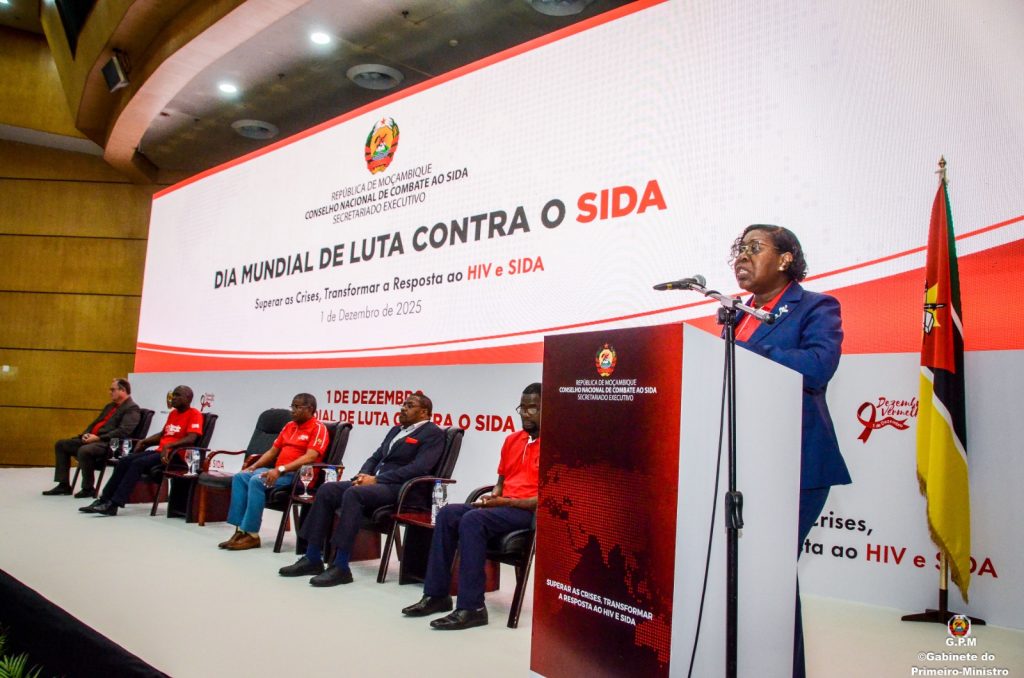
Primeira-ministra, Benvinda Levi cerimónias alusivas ao Dia Mundial da Luta contra o SIDA
Maputo, 2 Dec (AIM) – Mozambican Prime Minister Benvinda Levi announced on Monday that the country recorded, over the last year, 44,000 deaths related to HIV/AIDS, including 10,000 children.
According to the Prime Minister, who was speaking on Monday at the ceremony marking the World AIDS Day, which is celebrated worldwide (except for the United States) on 1 December, the health authorities also recorded, over the last year, 92,000 new HIV infections, 37 percent of which occurred among adolescents and young people, bringing the number of people living with HIV in the country to 2.5 million.
“These figures show the magnitude of the challenge we still face. Despite the progress achieved, the epidemic continues to disproportionately affect adolescents, young people, women, and children”, Levi said.
“Around 87 per cent of people living with HIV know their HIV status, 95 per cent are on treatment, and 91 per cent have a suppressed viral load. We are close to the global 95-95-95 targets”, she added.
The 95-95-95 targets are a set of goals established by UNAIDS to end the global HIV epidemic by 2030. They require that 95 percent of people living with HIV know their status, 95 percent of those diagnosed are on antiretroviral therapy (ART), and 95 percent of those on ART have a suppressed viral load.
She explained that these results were possible thanks to the implementation of differentiated service models, reinforcement of community-based approaches, and protection of access to antiretroviral treatment.
“However, the challenges persist, especially in calibrating testing in provinces with the highest HIV incidence. We will strengthen sex education in schools, reach over seven million students, expand self-testing to hard-to-reach populations, implement differentiated care models, deliver antiretrovirals at the community level, and reduce barriers of stigma and discrimination”, she promised.
For his part, the executive secretary of the National AIDS Council (CNCS), Francisco Mbofana, warned of signs of complacency among the population.
“Every citizen should be able to live with dignity and hope. Ending AIDS is everyone’s responsibility. We are in this mission together. No technology will have an impact if it doesn’t reach those who need it most. We need to invest in the communities, activists, and health professionals who sustain the response on a daily basis”, he said.
He also reiterated that the Health Ministry will introduce, in the first quarter of 2026, the pre-exposure prophylaxis (PrEP) in the National Health System.
PrEP, which will be introduced in the first quarter of 2026, is a medication taken by people who are HIV-negative to significantly reduce the risk of getting HIV through sex or drug abuse. It works by preventing the virus from establishing itself in the body if exposure occurs and is available as daily pills or long-acting injections.
(AIM)
NL/Ad/pf (467)