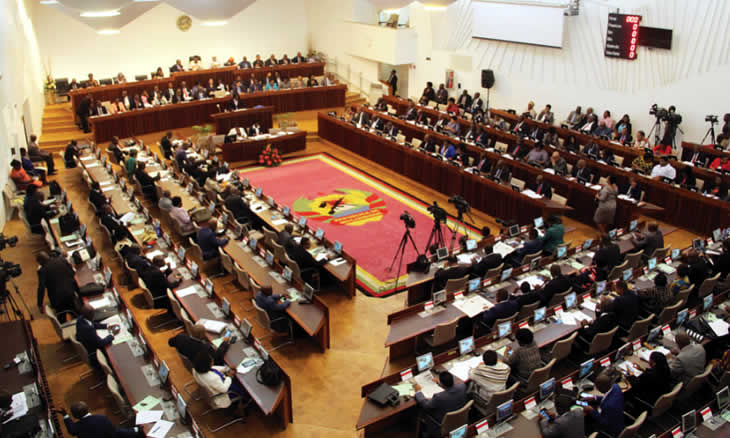


Assembleia da República, parlamento moçambicano
Maputo, 14 Dec (AIM) – The Mozambican parliament, the Assembly of the Republic, on Saturday approved the plan and budget (PESOE) for 2026.
The budget passed with 163 votes in favour, all from the ruling Frelimo Party. The 55 deputies present from the three opposition parliamentary groups – from the former rebel movement Renamo, from the Optimistic Party for the Development of Mozambique (Podemos) and from the Mozambique Democratic Movement (MDM) – all voted against.
The opposition parties had boycotted the previous parliamentary session, which discussed amendments to the tax codes, but they came back into the chamber for the vote on the plan and budget.
The government expects revenue in 2026 to reach 407 billion meticais (about 6.4 billion dollars, at the current exchange rate). But public expenditure will be much higher, at 520.6 billion meticais. This leaves the government facing a deficit of 113.7 billion meticais (seven per cent of GDP).
When she introduced the budget earlier in the month, Prime Minister Benvinda Levi told the Assembly she expects the deficit to be financed by domestic debt (2.2 per cent of GDP), foreign grants (3.2 per cent of GDP), and foreign loans (1.9 per cent of GDP).
This much the same as in previous years, and so covering the deficit is heavily dependent on the good will of foreign donors.
The Plan for 2026 forecasts a GDP growth rate of 2.8 per cent, considerably lower than the population growth rate.
The government believes that the main contributions to growth will come from the extractive industry, with a growth rate of 4.4 per cent, services (4.1 per cent), fisheries (3.6 per cent), construction (3.2 per cent), and agriculture (2.5 per cent).
The government’s projection for inflation in 2026 is 3.7 per cent. Levi told the deputies she expected commodity exports to reach 8.4 billion US dollars. The country’s net international reserves are projected to reach 3.2 billion dollars, enough to cover 4.4 months of imports of non-factor goods and services (excluding imports by the megaprojects).
In Saturday’s lacklustre debate on the plan and budget, Elisete Machava, speaking for the Frelimo parliamentary group, claimed that the 2026 PESOE expresses “the legitimate longings of Mozambicans and expresses the vision of development that Mozambique deserves”.
“We voted in favour”, she said, “because the 2026 PESOE is a structuring pillar of our governance, oriented towards promoting inclusive economic growth, reducing poverty, strengthening social cohesion and improving sustainably the quality of life of Mozambicans”.
Podemos deputy Mangaze Felizardo said the plan ignores an undertaking given to build 5,000 new houses to alleviate the housing problems facing young Mozambicans.
The plan does not prioritise critical areas, he claimed, and contains no measurable targets.
For Renamo, Juliano Picardo said the document “does not present robust operational plans, or specific public projects in social protection with an impact on the life of our people”.
He added that the plan lacks clear annual targets and indicators which would make it possible “to assess the impact on the extreme poverty which plagues Mozambicans”.
For the MDM, Jose Lobo claimed that the plan prioritises the central level of government to the detriment of the provinces, districts and municipalities.
(AIM)
Pf/ (535)