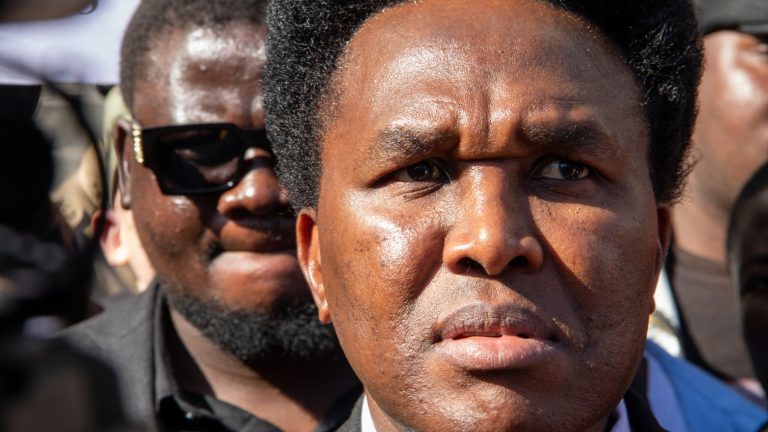
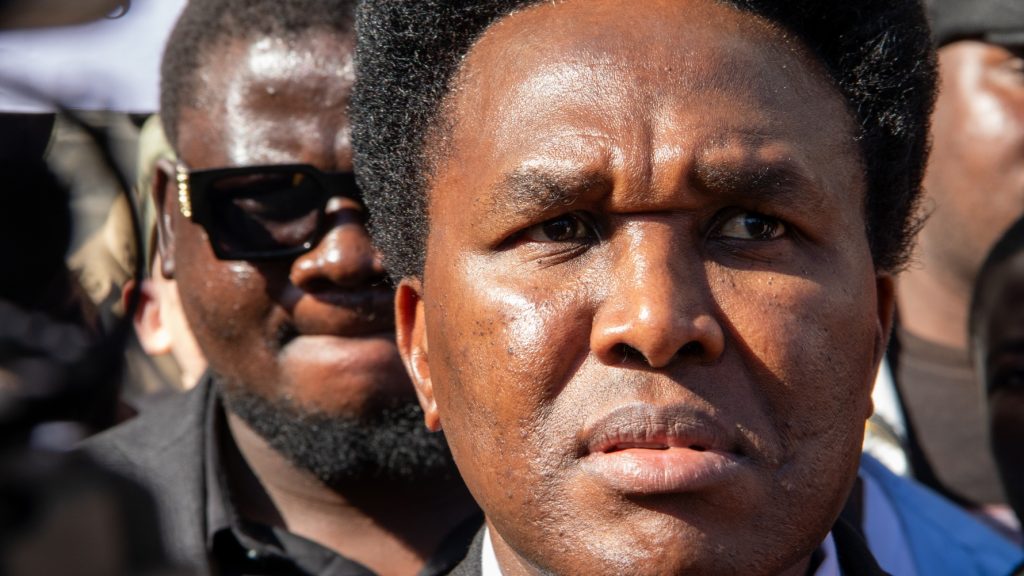
Venâncio Mondlane, falando em conferência de imprensa. Foto de Carlos Júnior
Maputo, 16 NOV (AIM) – Mozambique’s Supreme Court has chosen specific media outlets to cover the trial of Venâncio Mondlane, former presidential candidate and leader of the National Alliance for a Free and Autonomous Mozambique (Anamola).
Mondlane is accused of five criminal charges related to post-election mass demonstrations. The mass demonstration he called to protest against the alleged fraudulent results of the general elections held in October 2024 started peacefully but then degenerated into rioting.
He is accused of having committed the following crimes: public apology for a crime, incitement to collective disobedience, public instigation to crime, instigation and incitement to terrorism. Recently, the Council of State, the advising body to the Mozambican President, decided to lift Mondlane’s immunity in order to allow him to stand trial.
According to Pedro Nhatitima, Supreme Court spokesperson, the trial, which was scheduled to start on November 17, has only 45 seats for media companies, namely: the publicly-owned Televisão de Moçambique (TVM) and Rádio Moçambique (RM) and the daily newspapers “Jornal Notícias and “Diário de Moçambique.” It includes the private TV channels STV, TV Sucesso, TV Miramar, as well as the Portuguese News Agency (LUSA), and the Portuguese Radio and Television (RTP).
“Other national media outlets will have to compete for four rotating spots by registering via an electronic platform. For correspondents from foreign media outlets, only one spot has been made available, which is also subject to registration”, the spokesperson said. He did not reveal the criteria for the appointment of companies in question.
He explained that the general public will have access to 10 spots, while other institutions and civil society organizations will also benefit from reserved places, including the country’s Bar Association, the Support and Monitoring Group for the Implementation of the Phases (GAMIF), the Centre for Public Integrity (CIP), and the Centre for Democracy and Human Rights (CDD).
The limited spots for journalistic coverage of the trial are deemed as a measure to restrict press freedom in Mozambique.
According to Borges Nhuamirre, a senior journalist and member of the Mozambican chapter of the regional press freedom body MISA (Media Institute of Southern Africa), for the first time, the Mozambican justice system is set to try a high-ranking politician, while journalists face limitations in their coverage of the proceedings.
“This can only be described as a regression for press freedom and, by extension, freedom of expression. Excluding the press from covering an event of significant public interest, on the grounds of a lack of space, can only be defined as a restriction on freedom of the press and, consequently, on the freedom of expression of the Mozambican people, who constitute the audience for the media outlets that have been excluded”, Nhamirre wrote in his Facebook account.
The Supreme Court spokesperson also revealed that the trial will be presided over by five judges and will involve two deputy attorneys general, a legal assistant, two defense attorneys, and a total of 29 witnesses.
Am/