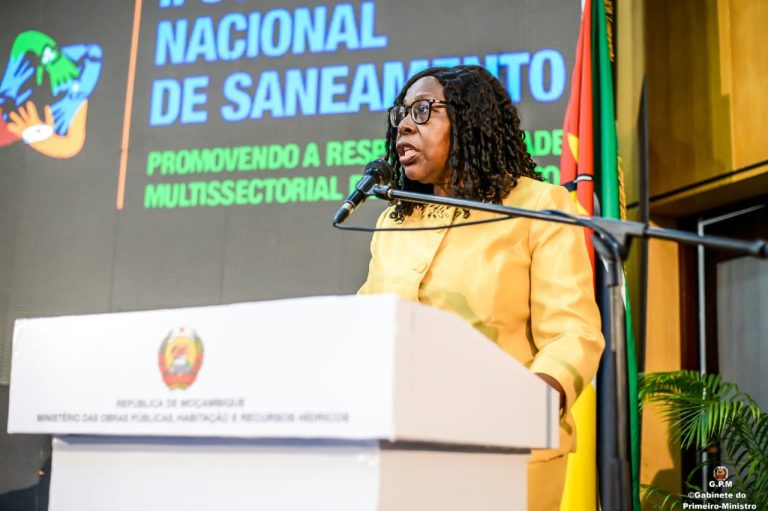
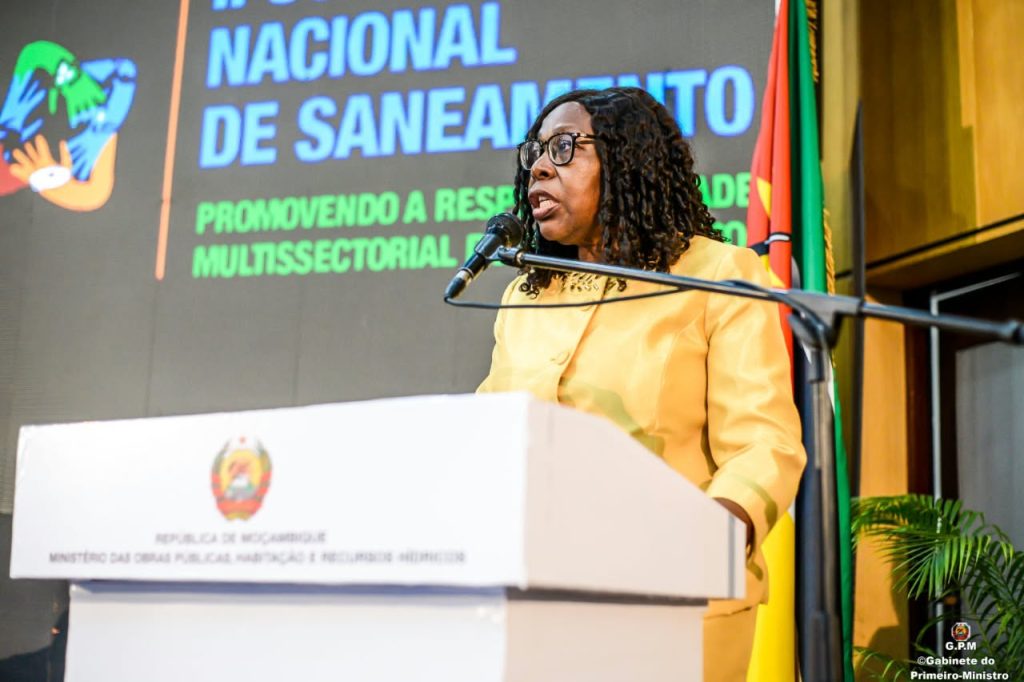
Maputo, 19 Nov (AIM) – Mozambican Prime Minister Benvinda Levi has announced that the exponential population growth places pressure on the delivery of public services, taking into account that the country records around 1.5 million births a year.
“In Mozambique, 1.5 million people are born every year. At our pace of development, we are always lagging behind”, said the Prime Minister at the opening of the 2nd National Sanitation Conference, taking place under the motto “Promoting Multisectoral Responsibility for Sanitation.”
According to Levi, the county needs a reflection on the impact of the demographic dividend on public policy-making and the country’s strategic decisions.
“It is important for us to reflect on how the demographic dividend affects public policies and what decisions we, as a country, will have to take in this regard”, she said.
Data presented at the conference indicate that, between 2014 and 2024, coverage of basic sanitation services increased from 25.9 to 38.6 percent. Over the same period, the proportion of the population practicing open defecation fell from 33.4 to 16 percent.
However, despite this progress, in 2024 more than six in every ten Mozambicans still lacked access to at least one basic sanitation service.
To address this shortfall, according to Levi, the government set a target in its 2025–2029 Five-Year Government Programme to increase the proportion of the population with access to adequate sanitation services from 37 to 44 percent by 2029.
Among the planned interventions, she announced the construction of wastewater treatment plants in the central cities of Chimoio and Beira, the rehabilitation of sewerage networks in Quelimane and Maputo, and the expansion of connections to sanitation systems in the cities of Maputo, Beira, Tete and Quelimane.
Levi also highlighted the need to strengthen the protection of water sources, ensure the maintenance of drainage systems and improve the collection, transport and treatment of faecal sludge, particularly in the most vulnerable areas.
“By 2024, more than 476,000 people had benefited from improved basic sanitation conditions. During the same period, more than 1,300 communities in the provinces of Manica, Sofala and Tete had been supported and certified as free from open defecation”, Levi said.
Am/