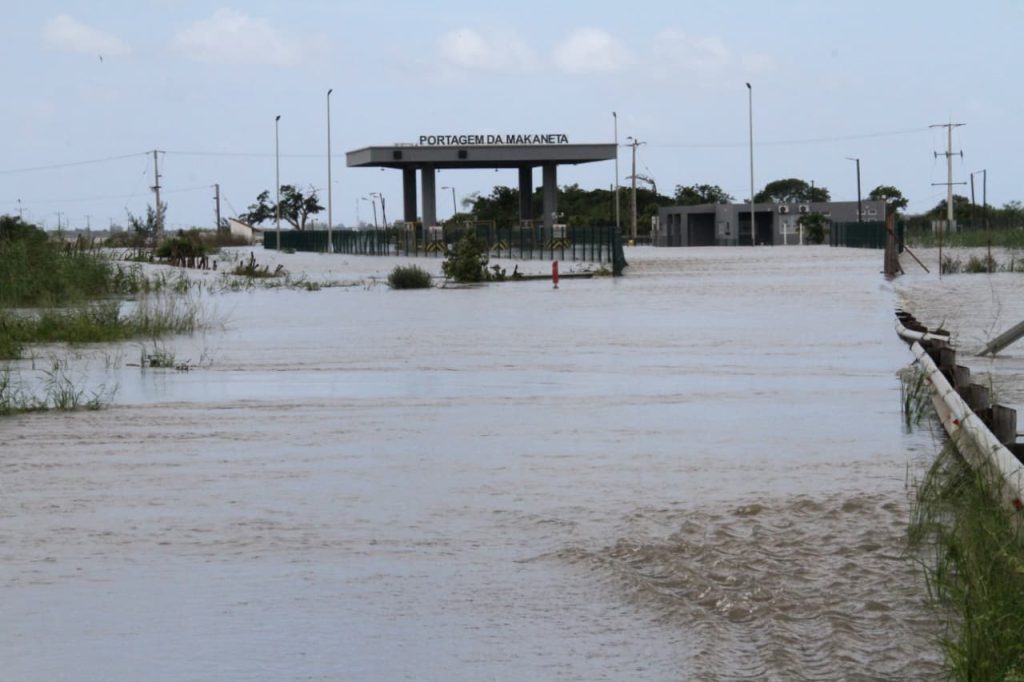
Portagem de Macaneta parcialmente submersa pelas cheias
Maputo, 30 Jun (AIM) – Mozambique’s National Meteorology Institute (INAM) has revealed that the country’s 2025–26 rainy season started earlier across almost the entire national territory.
The rainy season in Mozambique runs from October to April. During the 2025-2026 rainy season was characterized by floods, particularly in the southern and central regions of the country, causing over 290 deaths.
According to INAM report on the 2025–26 rainy season, the country’s most recent rainy season was characterized by an “early onset” of rainfall. “Large parts of the country’s northern zone and the far north of Inhambane province recorded an early onset of rains by more than 20 days.”
However, scattered areas within the central provinces of Zambézia, Sofala, Tete, and Manica recorded rainfall starting at the usual time, though with a tendency toward an early start.
“The southernmost parts of Gaza and Inhambane provinces and a large portion of Maputo province experienced a delayed start, lagging about 10 days or more behind the normal, although a small area in the far southeast of Maputo recorded an early onset of about 20 days”, reads the report.
The 2025–26 rainy season, reads the document, saw more than five days of “extreme or unusual rainfall, occurring most frequently in the central and northern regions.
Last February, weather stations recorded extreme rainfall across large areas of the Niassa, Zambézia, and Tete provinces, as well as parts of Nampula and Manica.
“This type of phenomenon is concerning, as it causes various impacts—such as river flooding, urban flooding, soil erosion, landslides, the destruction of crops and infrastructure, and outbreaks of waterborne diseases”, reads the document.
According to the report, in most provinces in the country’s southern zone, where the rainy season climatologically ends in March, the season experienced delays that, in some areas, exceeded 30 days relative to the climatological average.
“This situation highlights an extension of the rainy season beyond the normally observed period, maintaining wet conditions during the transition phase to the dry season. A similar situation was observed in the country’s central region”, reads the report.
The document points out that this delay means the rains ceased later than usual, extending the rainy season beyond the expected timeframe. “This is influenced by above-average precipitation across most of the country, driven by the combined influence of global, regional, and local climatic factors.”
AM/