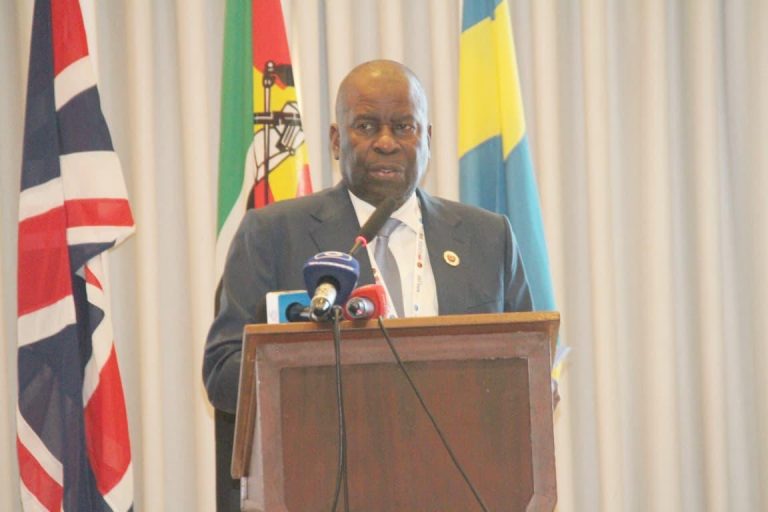

Antigo ministro moçambicano das Finanças, Manuel Chang
Maputo, 8 Apr (AIM) – Mozambique’s former finance minister, Manuel Chang, returned to Maputo on Sunday, after serving a sentence of 102 months for fraud and money laundering for his role in Mozambique’s largest scandal, known as the case of the “hidden debts”.
The term “hidden debts” refers to the scheme whereby three fraudulent Mozambican state companies, Proindicus, Ematum (Mozambique Tuna Company), and MAM (Mozambique Asset Management), all of them run by the security service, SISE, obtained loans of over two billion US dollars from the banks Credit Suisse and VTB of Russia.
No bank in its right mind would give such huge loans to companies with no track record and run by an intelligence service. But any qualms that Credit Suisse and VTB may have had were overcome when Chang, as Finance Minister, signed sovereign guarantees, which meant that, if the companies defaulted, the Mozambican state would repay the banks.
And, sure enough, all three companies soon went bankrupt, and so the hidden loans became hidden debts. The guarantees signed by Chang were illicit, since the loans smashed through the ceiling on lending established under the 2013 and 2014 budget laws.
The loans were a corrupt scheme designed by the Abu Dhabi-based group Privinvest, which spent hundreds of millions of dollars in bribing Mozambican officials (including Chang) and Credit Suisse bankers. Under these deals, Privinvest became the sole contractor for the three fake companies and sold them fishing boats, radar stations and other assets at vastly inflated prices.
Chang was arrested at Johannesburg international airport in December 2018, on an international arrest warrant issued by American prosecutors. Because American investors were among those swindled in the scandal, the US wanted Chang to stand trial in New York.
Belatedly, the Mozambican authorities said that Chang should be put on trial in Maputo. Chang’s lawyers worked for five years to avoid extradition to the US. Eventually, they failed and in 2023 Chang was deported from Johannesburg to New York.
He was found guilty of conspiracy to commit wire fraud and money laundering, and judge Nicholas Garaufis sentenced him to a jail term of eight and a half years.
Chang’s defence team attempted to secure his earlier release, on health grounds. The judge rejected the request since he did not believe that the lawyers had provided compelling evidence of any serious medical condition that would justify early release.
Chang was freed from a US federal prison on 26 March, but an attempt to deport him immediately failed. Chang’s lawyers bought him an air ticket from Boston to Maputo, via Lisbon – but the Portuguese airline TAP did not allow him to board the plane.
Chang was held by the US Immigration and Customs Enforcement agency at Boston’s Logan Airport, because his emergency travel document, issued by the Mozambican embassy in Lisbon, was not previously authorised by the Portuguese authorities (who would be responsible for the former minister during his transit).
So Chang remained under ICE custody until this bureaucratic snag could be sorted out.
According to Radio France Internacional, the deportation was held up until Sunday, when he was put on a scheduled Ethiopian Airways flight from Addis Ababa to Maputo, arriving in the Mozambican capital in the early afternoon.
Prior to the New York trial, the Mozambican Attorney-General’s Office (PGR) insisted repeatedly that Mozambique was the only country with the legitimacy to bring Chang to trial.
Indeed, the PGR had drawn up a long list of crimes with which it intended to charge Chang. But no attempt was made to arrest Chang on his arrival.
(AIM)
Pf/ (601)