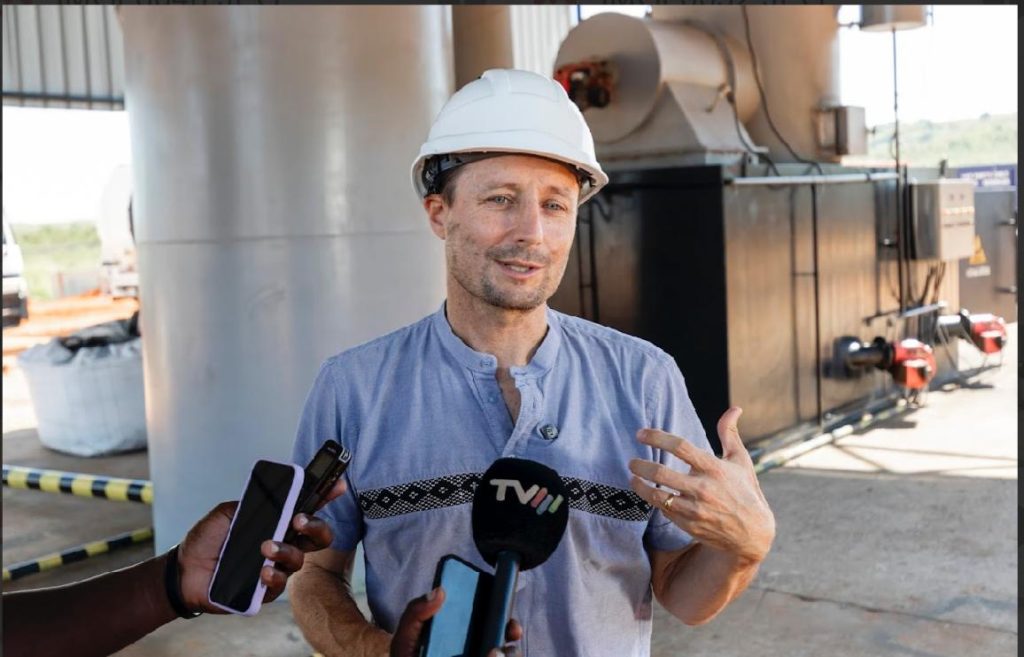
Laurent Corthay, chefe da missao do Banco Mundial que monitora a implementacao do projecto Conecta Negocios em Cabo Delgado
Pemba (Mozambique), 27 Apr (AIM) – The World Bank’s new approach in northern Mozambique is focused on job creation, private sector funding and strengthening entrepreneurial skills.
This statement was expressed by the head of the World Bank mission, Laurent Corthay, in an interview with AIM.
According to Corthay, speaking on the sidelines of a session monitoring and evaluating the impact of World Bank-financed projects in the northern province of Cabo Delgado, the Bank’s focus is aligned with the objectives of the Mozambican government, with job creation considered “the country’s greatest challenge.”
“Jobs are the most direct and efficient way out of poverty. Therefore, the World Bank is funding the Connect Businesses project, through which 30 million Euros (35.2 million Us dollars at the current exchange rate) in grants are being mobilized for Mozambican companies, with a view to accelerating economic linkages and boosting value chains”, he said.
This project, which is coordinated by the Mozambican Finance Ministry, is budgeted at 15 million US dollars disbursed by the World Bank.
The initiative is aimed at training, funding and preparing small and medium-sized enterprises (SMEs) in order to integrate them into the supply chains of large companies in Mozambique, with a focus on the Nacala Logistics Corridor, in the northern province of Nampula.
In parallel, 20 million Euros is earmarked for business training and capacity-building programs, considered essential to improve the performance of small and medium-sized enterprises.
Corthay explained that, although access to financing is often cited as the main obstacle to the development of the private sector, training plays an equally critical role. “It’s not just about creating new businesses, but about transforming the way business is conducted”, he said.
The mission found on the ground that beneficiary companies, especially small enterprises, registered significant improvements thanks to capacity-building actions, including greater internal organization, better team structuring and increased entrepreneurial initiative.
Regarding the future, Corthay said the World Bank’s support to the country should continue, “strengthening the private sector, access to financing, and skills development.”
Cabo Delgado, in particular, was identified as a priority, not only because of its need for economic recovery but also for its role in promoting stability. “Job creation and stability are central and interconnected dimensions”, he said.
The recommendation given to companies by the bank representative highlights the need to continuously invest in improving their capabilities, adopting more efficient management practices, and strengthening the training of their human resources.
The World Bank believes that this approach can consolidate an inclusive development model in which the private sector plays a decisive role in the country’s economic transformation.
(AIM)
Pc/Ad/pf (439)