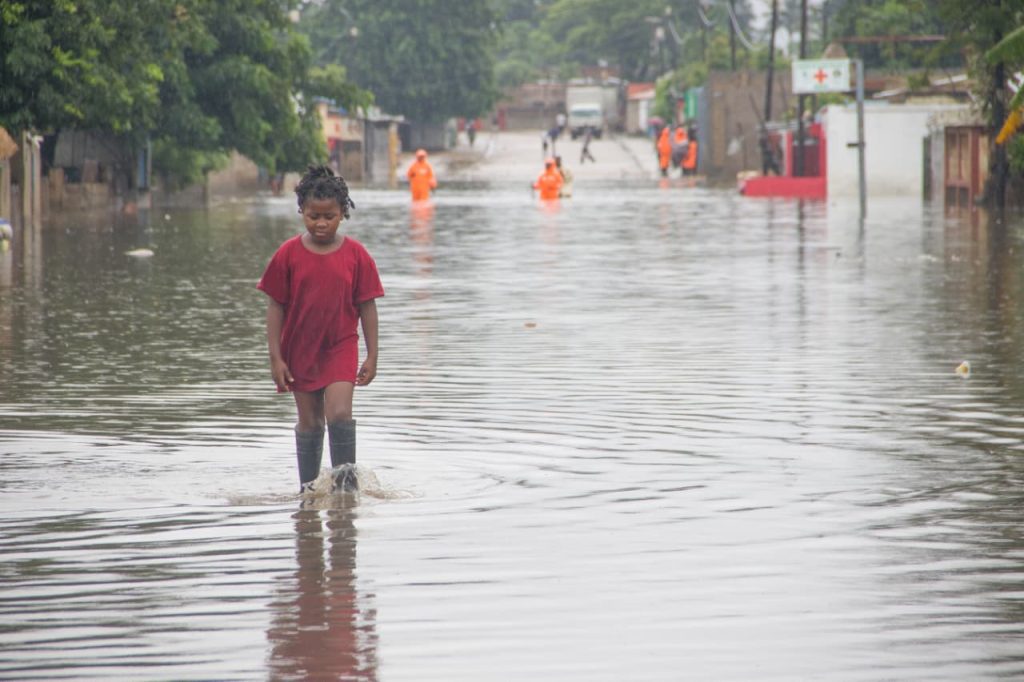
Cheias urbanas na cidade de Maputo
Maputo, 8 Jul (AIM) – Mozambican government has announced that the Comprehensive Post-Flood Recovery and Reconstruction Plan is valued at 102 billion meticais (about 1.6 billion US dollars at the current exchange rate).
According to the government spokesperson and Minister of State Administration, Inocêncio Impissa, speaking to reporters after a meeting of the Council of Ministers (cabinet), the funds are intended to address damage caused by the floods, which affected housing, public and private infrastructure, agriculture, and other economic sectors.
Impissa explained that the impact assessment indicates financial damage estimated at 69.5 billion meticais, economic losses of approximately 41.37 billion meticais, and recovery needs and losses calculated at around 102 billion meticais.
According to the spokesperson, the recent weather events, combined with key political and economic developments in the country, resulted in a downward revision of the Gross Domestic Product (GDP) growth forecast, which fell from 2.8 percent to 0.59 percent.
“The 2026 Comprehensive Post-Flood Recovery and Reconstruction Plan aims to promote a resilient, inclusive, and sustainable recovery of the affected areas, ensuring socio-economic stabilization, the restoration of livelihoods, and the strengthening of response capacity for future disasters”, he said.
The 2026 floods affected approximately 724,000 people in the provinces southern of Gaza, Inhambane and Maputo, and central provinces of Sofala, Manica, and Zambézia.
According to the spokesperson, the disasters impacted poverty levels, food security, livelihood recovery, and community response capacity.
The plan is based on five fundamental priorities: immediate humanitarian assistance, the restoration of essential services, the construction of resilient infrastructure, economic recovery, and disaster risk reduction.
The government also approved the Medium-Term Fiscal Scenario (CFMP) for the 2027–2029 period. This macro-fiscal and budgetary planning instrument defines the fiscal strategy, macroeconomic and fiscal projections, and overall public expenditure limits for a three-year horizon, serving as the basis for preparing the Economic and Social Plan and State Budget (PESOE).
“The document aims to strengthen discipline, predictability, and transparency in public finance management. The instrument establishes a prudent, realistic, and feasible fiscal framework geared toward macroeconomic stability and the sustainability of public finances”, he said
(AIM)
MR/Am/