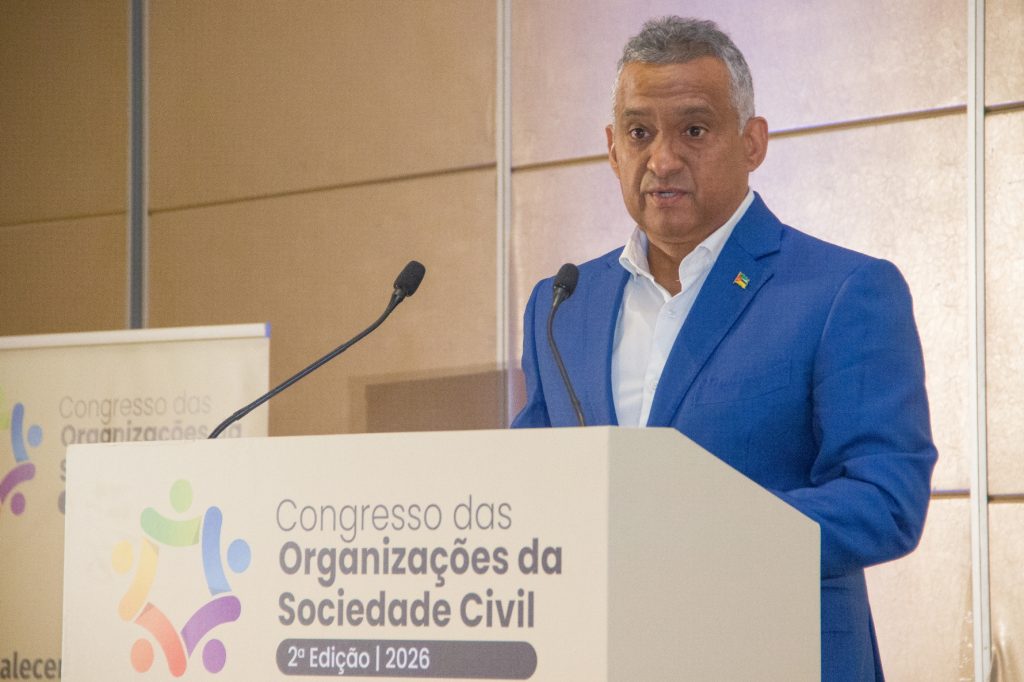
Ministro da Planificação e Desenvolvimento, Salim Valá, profere o discurso de abertura na 2° Edição do Congresso das Organizações da Sociedade Civil. Foto de Carlos Júnior
Maputo, 14 May (AIM) – The Mozambican Minister of Planning and Development, Salim Valá, believes that Civil Society Organizations (CSOs) are crucial partners for sustainable development, social inclusion, and consolidation of the Democratic Rule of Law.
According to the minister, speaking on Wednesday, in Maputo, at the opening of the 2nd CSO Congress, a two-day event held under the theme “Strengthening Civil Society: Partnerships, Sustainability and Innovation for Inclusive Development”, development can no longer be seen as the exclusive responsibility of the State, it also demands civil society’s effort.
“Today, more than ever, development cannot be understood as the sole responsibility of the Government. The contemporary paradigm of sustainable development is increasingly based on the logic of collaborative governance, citizen and collective participation”, he said.
According to the minister, civil society has ceased to be merely a space for demands and has asserted itself as a promoter of social inclusion, active citizenship, and bringing public policies closer to communities.
“Without the strength and participation of CSO, in many regions of the country, it would be difficult to guarantee social assistance, psychosocial support for communities, and the strengthening of actions in the health sector”, he said.
The minister also said that the country has faced structural challenges, despite the progress made in the health, education, water supply, and energy sectors.
Therefore, he advocated the need to consolidate “a new generation of partnerships, based on transparency, inclusion, and orientation towards concrete results.”
“We need to consolidate smarter, more transparent, more inclusive partnerships, increasingly based on trust”, he added.
The minister also revealed that the country’s third sector economy – which includes private non-profit organizations (NGOs, foundations, associations) – currently represents between two and three percent of the national Gross Domestic Product (GDP) and employs over 60,000 people.
“The impact goes beyond direct jobs, as many organizations operate in crucial areas such as education, humanitarian assistance, health, and rural development. CSOs have the capacity and expertise to work with communities, to do work in the villages. They have important comparative advantages”, he said.
Addressing the congress participants, the minister called for the building of institutional relationships based on trust, dialogue, and cooperation.
“Sustainable development is also built on trust, credible institutions, inclusion, participation, and human capital. There is a need to build bridges between the State, the private sector, communities, and civil society to ensure more inclusive and sustainable development in the country”, he said.
(AIM)
NL/Ad/