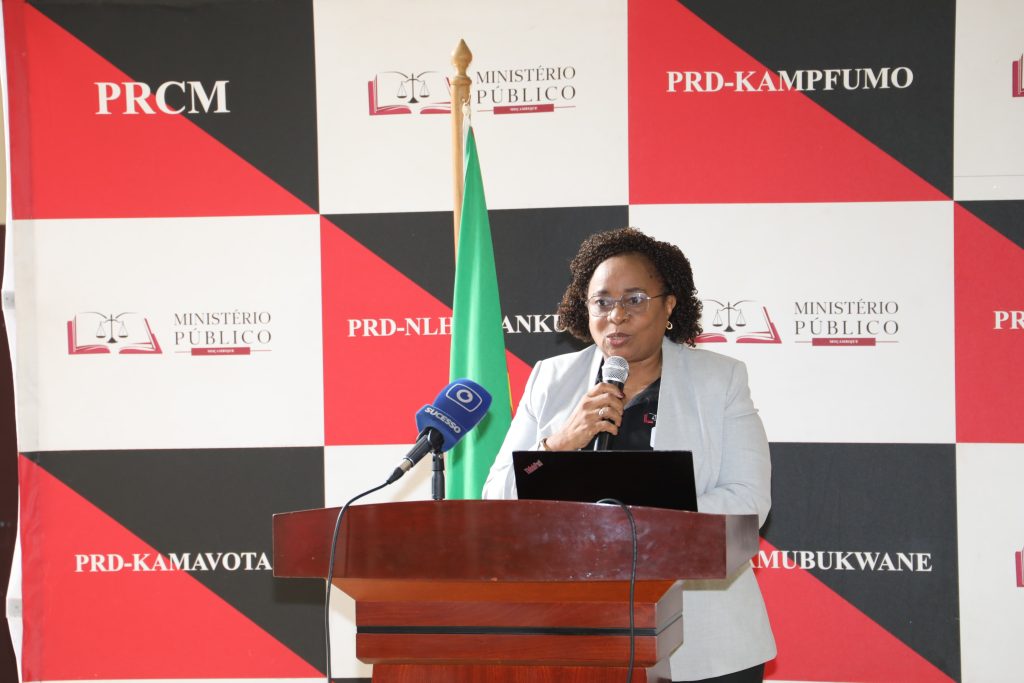
Vice Procuradora Geral da República, Irene Uthui
Maputo, 22 May (AIM) – The Mozambican Attorney-General’s Office (PGR) has expressed its concern at the growing circulation of drugs and alcoholic drinks near public schools.
The Deputy Attorney-General, Irene Uthui, speaking in Maputo at a meeting aimed at coordinating activities with Anti-Drug Groups in schools, explained that “it is not uncommon for some ill-intentioned vendors to promote the sale of drugs and alcoholic beverages at the school gates.”
The Anti-Drug Groups include staff from the Central Office for Drug Prevention and Control, teachers, students and other entities.
According to the Deputy Attorney-General, the weakness of access control mechanisms to school premises facilitates the entry of students carrying illegal substances.
“For this reason, schools urgently need to improve coordination at various levels, designing programs and concrete prevention actions, as well as training and capacity building on how to prevent use and sale of drug and alcohol in schools, a situation that greatly concerns us due to the high number of children, adolescents, and young people who use and sell drugs on school premises”, she said.
In 2024, the country’s National Inspectorate of Economic Activities (INAE) announced a ban on advertising alcoholic drinks near public institutions, especially schools and health units.
The measure, which is part of a decree on advertising code, pointed out that advertisers of alcoholic drinks must leave a minimum distance of 500 meters between their billboards and public institutions such as schools, hospitals, hotels and police stations.
This measure also aimed at stopping advertising alcoholic drinks to minors, since there has been an upsurge in the consumption of alcohol by children (even though the sale of alcoholic drinks to anyone under the age of 18 is illegal).
However, the authorities have been failing to monitor the implementation of this measure. There are still many public institutions (particularly schools) surrounded by establishments selling alcoholic drinks.
According to Emília Araújo, Secretary of State for Youth, the drug problem currently represents one of the greatest social, health, and public safety challenges.
“In the school context, this reality takes on particularly worrying dimensions, since schools, spaces intended for the academic, moral, and civic education of young people, have been increasingly affected by the circulation and consumption of psychoactive substances”, she said.
Therefore, she said, Anti-Drug Groups play a strategic role in youth mobilization, preventive education, promotion of healthy lifestyles, and strengthening youth citizenship.
“The presence of drugs in schools compromises the teaching and learning process, favoring an increase in violence, school dropout, and juvenile delinquency”, she said.
(AIM)
MR/Am/