
Maputo, 22 May (AIM) – Mozambique currently cultivates just over 6.5 million hectares of land out of 36 million hectares of arable land available in the country, and family farming continues to dominate national agricultural production.
According to the III Agricultural Census (CAP 2023/24), carried out by the National Institute of Statistics (INE), the land that is currently cultivated corresponds to 17.8 percent of the total arable land available in the country.
The survey was carried out between December 2024 and May 2025, covering 142 of the country’s 161 districts, equivalent to 88.2 percent territorial coverage. Six districts in the northern province of Cabo Delgado were not covered to the insecurity caused by the islamist terrorism.
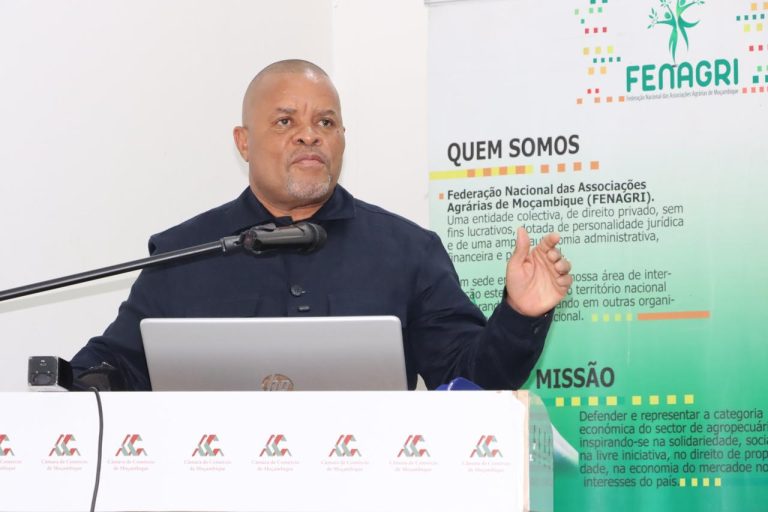
According to Salim Valá, Minister of Planning and Development, speaking on Thursday, in Maputo, during the presentation of CAP 2023/24, these figures represent structural challenges and the enormous potential for transformation of the Mozambican agricultural sector.
“The fact that only about 17.8 percent of the available arable land is currently cultivated unequivocally demonstrates that Mozambique continues to possess one of the largest strategic reserves of agricultural potential on the African continent,” he said.
The minister believes that the future of the country’s economic transformation will depend on the ability to convert subsistence agriculture into commercial, resilient, and agro-industrial-oriented agriculture.
According to the document, Mozambique has approximately 5.2 million farms, of which 99.9 percent are small and medium-sized farms. More than 84 percent of farms have less than two hectares, which continues to limit productivity levels and access to technical assistance. The survey also points out that 38 percent of farms are headed by women.
In the livestock subsector, the document points to an estimated national population of approximately 2.4 million cattle, 4.2 million goats, and approximately 16 million chickens of local breeds.
The CAP 2023/24 also surveyed 42,657 agricultural and livestock farms, including 36,213 small farms, 5,561 medium-sized farms, and 883 large farms.
For the first time, Mozambique has disaggregated agricultural and livestock data down to the district level, considered an important step forward for planning public policies aimed at food security, rural development, and agricultural investment.
In his part, the World Bank representative in Mozambique, Rinku Murgai, considered that the document represents “much more than a statistical exercise. The new data could support the identification of priority value chains, strengthen agricultural productivity programs, and guide investments in the sector.”
MR/Am/